

Executive Summary:
- Valuation Leaders: Anthropic (estimated market cap of $370 billion), is one of three highly valued private “AI Foundation Model Providers” alongside OpenAI ($782 billion) and xAI ($244 billion) based on January 30, 2026 PM Insights market cap data. Valuations drop significantly to less than $15 billion for the next tier of private firms.
- Public Market Gap: The public market has only two “pure-play” Anthropic peers, the recent IPO Chinese companies Knowledge Atlas Technology (also known as Zhipu AI) and MiniMax, which are a fraction of Anthropic's size.
- Big Tech Involvement: Nine public companies, including five members of the Magnificent Seven (Amazon, Alphabet, Microsoft, Meta, Nvidia), have a product line aligned with Anthropic’s business classification but do not attribute revenue to it.
- It’s Complicated: The relationships between Anthropic and leading U.S. megacap tech companies are complex because these firms both invest in Anthropic and compete with it, creating overlapping partnerships, rival model efforts, and circular spending across cloud and AI ecosystems.
Background
In early December, the Financial Times reported that Anthropic had engaged the law firm Wilson Sonsini to prepare for a potential initial public offering as soon as 2026. This news followed an October report indicating that OpenAI was also weighing an IPO, possibly in the latter half of 2026, though more likely in 2027.1 Meanwhile, in early January of this year, two Chinese AI foundation model providers went public: Knowledge Atlas Technology and MiniMax.
The artificial intelligence (AI) industry is entering a pivotal phase, driven by a small group of private firms that dominate the development of foundation models, the core technology behind generative AI applications. The implications are significant: the emergence of publicly traded AI foundation model firms could reshape technology investment strategies, introduce new valuation benchmarks, and accelerate competitive dynamics across the broader AI ecosystem. While AI is in its relative infancy, it is coalescing around a small group of private firms and some well known giants as they battle to define the next era of computing.
Anthropic Profile
This analysis is focused on identifying and evaluating the private and public company peers of Anthropic, with a focus on those companies with large, multi-dimensional foundation models designed for broad reasoning and versatility. The insights presented are based on proprietary data and methodologies from PM Insights’ venture capital universe and Syntax Data’s company classification technology.
Anthropic is an artificial intelligence company developing foundational large language models that power consumer-facing AI assistants, enterprise tools, and APIs that enable businesses to integrate AI into products and services.
Anthropic Private Peers
Anthropic has 13 private peers that match its “AI Foundation Model Provider” primary business classification. This group can be split into three categories:
- Megacap Leaders: Anthropic ($370 billion), OpenAi ($782 billion), xAI ($244 billion).
- Small/Mid Cap firms: This second tier includes Mistral AI ($13 billion), Cohere ($6 billion), Liquid AI ($3 billion) and AI21 Labs ($1 billion).
- Emerging firms: This group of seven consists of firms with limited liquidity and pricing data.2

The table below highlights valuation and revenue data for the megacap and small/mid cap firms. The valuation data is as of January 30 and the most recent revenue estimates are provided with the revenue data dates and sources as noted. A valuation multiple (the Valuation / Revenue column) takes the current market value divided by the most recently available revenue estimate. Given the growth rates of these companies and their valuation volatility, this metric can change quickly. Five of the seven companies trade in a range between 26 and 41 times revenue, including Anthropic (41x). Open AI (39x) has a similar multiple as Anthropic but a valuation approaching $800 billion. xAi, which was acquired by SpaceX on February 2 in a transaction that valued the SpaceX business at $1 trillion and xAI at $250 billion,3 has a multiple of nearly 500 times revenue. Similarly, Liquid AI trades at a very high multiple of 240 times revenue based on available data.

Anthropic Public Peers
It is difficult to think about Anthropic and OpenAI without immediately associating them with tech giants Microsoft, Alphabet, Nvidia, Amazon and Meta Platforms given how often these firms are paired in headlines. Our analysis explores these companies as peers to Anthropic, but public peers have multiple dimensions, and our analysis looks at peers from two levels:
- Company-level peers: Our public peer analysis starts by identifying firms that are holistically, at the firm level, similar to Anthropic with its more singular focus. Since the megacap tech stocks, to varying degrees, have multiple business lines and revenue sources, they are not strong peers to Anthropic at the firm level.
- Product line-level peers: We identify product lines of companies that match Anthropic’s AI Foundation Model Provider classification, and this is where the tech giant stocks appear. That is, these tech giants are conglomerates that do many things, much of which is unrelated to providing AI models, but Syntax’s classification data is able to identify the companies that have product lines that overlap heavily with Anthropic, even if the company as a whole does not. Of important note, some companies report product line revenue results while others detail the product offering but do not attribute any revenue. In cases where revenue is not attributed, it could be for a number of reasons, including: the revenue is embedded in other products or services; disclosure is made to communicate strategic plans or R&D initiatives as required by financial reporting standards; or, in limited cases, the product is not yet generating revenue. Alphabet’s Waymo autonomous car product line is a good example of a company providing transparency to investors on a strategic initiative without attributing specific revenue figures.
Anthropic Public Company Level Peers
To identify companies whose overall business model and product mix closely align with Anthropic, Syntax calculates a similarity score. The score measures the overlap between company business models and the revenue contribution of each product line; earning similar amounts of revenue from similar activities leads to a higher score. The score ranges from 0.0 to 1.0, with a score of 1.0 being a perfect match.
The emerging and dynamic nature of the AI market was on display in early January with the back‑to‑back IPOs of Knowledge Atlas Technology and MiniMax. This marks an inflection point in China’s AI sector, signaling that the country’s leading model developers are shifting from subsidy‑driven growth to capital‑market validation. Presently, Knowledge Atlas Technology and MiniMax, with respective 1.0 and 0.91 similarity scores, are the only two “pure play” companies that match Anthropic's AI Foundation Model Provider primary business classification. The remaining peers in the table below have similarity scores ranging from 0.45 to 0.31 as shown.
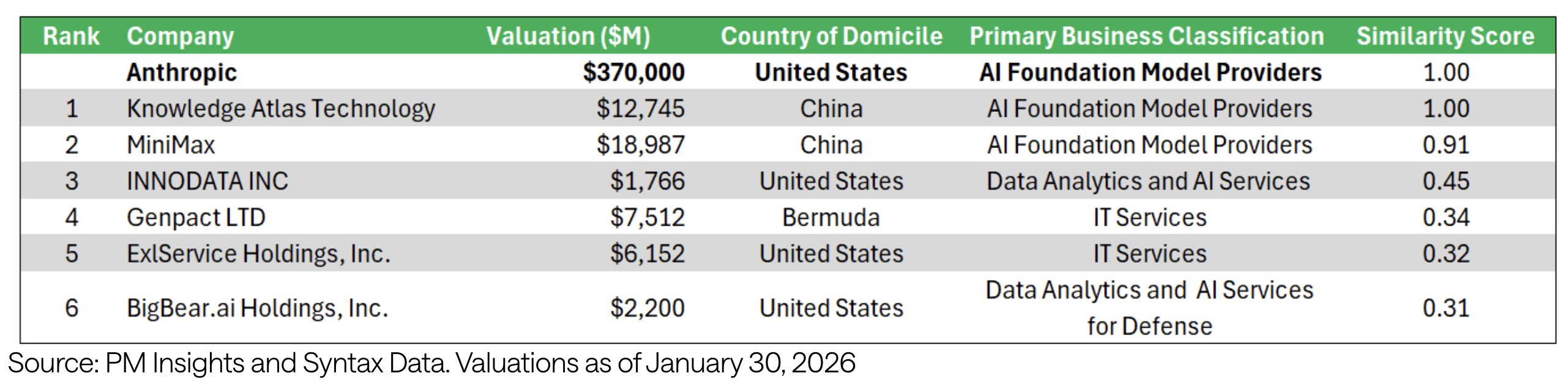
There is a steep drop from MiniMax’s 0.91 similarity score to the next closest peer, Innodata, and its score of 0.45. This decrease is driven by the fact Innodata has 83% of its ’s revenue tied to its “Data Analytics and Artificial Intelligence” product line, but it does not have a foundation model product line.
Anthropic Public Product Line Peers
The next level of peer group analysis looks specifically for companies that report a product line classification tagged as “AI Foundation Model Provider.” In this analysis, Syntax calculates similarity scores to these revenue segments as if they were standalone companies. The table below shows eleven companies offering a product with a similarity score of 1.0 that matches Anthropic’s product line classification.

The analysis generates some the interesting observations:
- Both Knowledge Atlas Technology and MiniMax appear as company peers above and here as product line peers, which is expected given their pure play focus on AI.
- The total revenues of Knowledge Atlas Technology ($44 million) and MiniMax ($30 million) and their respective market caps ($10 - $20 billion) do not compare to Anthropic, even setting aside the geographic differences.
- For all nine peers beyond the recent Chinese IPOs, none report product line revenue associated with the AI Foundation Model Provider product line.
- Six are U.S. companies including five of the Magnificent Seven (Alphabet, Amazon, Meta, Microsoft, Nvidia) plus IBM. The remaining three are China/Hong Kong domiciled: Tencent, Alibaba, Baidu.
- Anthropic’s estimated market cap of $370 billion is slightly less than Alibaba ($405 billion) and higher than the $286 billion market cap of IBM.
A Web of Complex Interrelatedness
The analysis of Anthropic's peer landscape reveals that the AI ecosystem is not a simple competitive field but a complex web of interrelatedness. While Anthropic, as a leading private foundation model provider, defines the frontier of technology, many of the world’s largest technology firms are simultaneously partners, investors, and formidable direct competitors. Their strategies for engaging with foundation model providers differ significantly. Microsoft, Amazon, and Nvidia primarily leverage partnerships to drive demand for their core cloud and semiconductor businesses. Alphabet and Meta focus more on internal development to maintain a proprietary, full-stack advantage in their consumer and ad-driven product lines. The following graphic highlights Anthropic’s relationships with these and other leading tech firms.
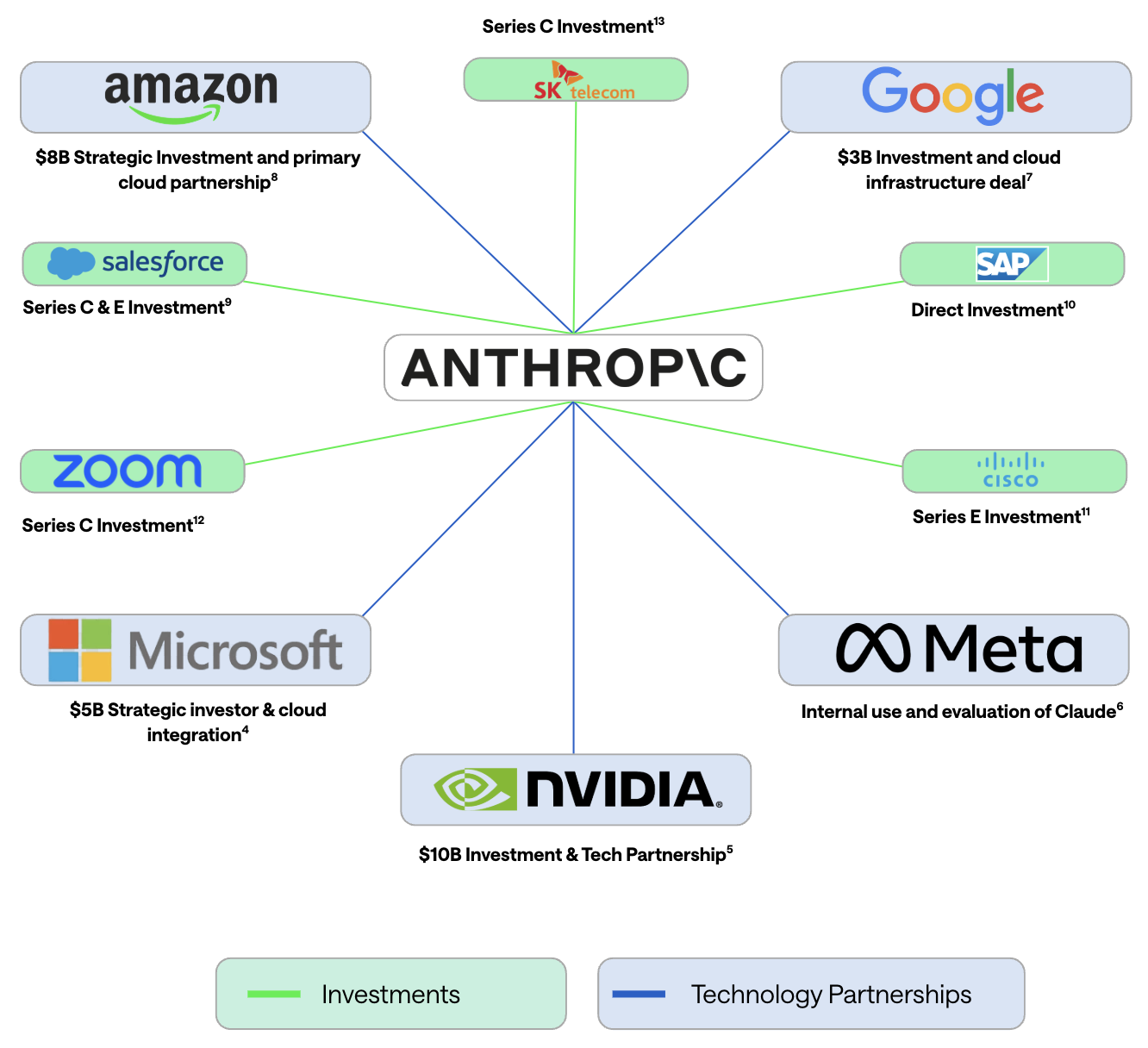
Some notable highlights include:
- Microsoft will invest up to $5 billion in Anthropic while Anthropic has committed to purchasing ~$30 billion of Azure compute.4
- Nvidia will invest up to $10 billion while Anthropic will purchase compute capacity up to one gigawatt.5 This one gigawatt equates to the output of a typical nuclear reactor according to the U.S. Department of Energy.
- Alphabet (Google) invested roughly $3 billion while agreeing to supply Anthropic with up to 1 million TPUs (Tensor Processing Units).7
- Amazon has invested $8 billion in Anthropic, and Anthropic uses AWS Trainium and Inferentia chips.8
It is important to note that the uses for AI foundation models is broad, and the relative performance of a model can vary by task. Anthropic’s latest Claude models continue to be the performance leader in tasks related to software coding.14 It’s strength in this area and its disruptive impact on the software industry was on display recently – the S&P North America Software Index was down 15% in January, its worst performing month in nearly twenty years.15 This level of market fallout underscores just how rapidly its capabilities are reshaping competitive dynamics across the entire software sector. At the same time, Google’s Gemini family has advanced rapidly over the past year, with models such as Gemini 3 Pro and the emerging Gemini 3.5 demonstrating broad, high‑level performance across scientific reasoning and deep thinking tasks.16 Bridgewater noted in a recent article “Both external testing and our own internal testing indicates that Gemini 3 is the best publicly available model in terms of raw intelligence and reflects the biggest jump in frontier model capabilities we’ve seen in a while.”17
Conclusion
The PM Insights’ database, in addition to Anthropic, identified 13 VC firms whose primary business was classified as “AI Foundation Model Provider”. Within this private company universe, seven were characterized as emerging. As such, these firms were not viewed as peers to Anthropic. This left a group of six companies from which two, Open AI and xAI, can be considered true peers. This is not a surprise as these three highly valued private firms dominate the development of AI foundation models. Perhaps somewhat surprising, these dominant private firms have no true, pure play public peers. The closest comparisons by business model are Knowledge Atlas Technology and MiniMax, the two recent Chinese IPOs. However, with market valuations in the $10 to $20 billion range, these firms are a fraction of the size of the dominant US based companies.
The AI ecosystem is defined by a complex web of interrelatedness where Amazon, Alphabet, Meta, Microsoft, and Nvidia can act simultaneously as Anthropic’s partners, investors, and competitors. While each of these conglomerates reports its own foundation model product line, their financial disclosures do not attribute specific revenue to these models. Instead, these firms primarily leverage AI to drive demand for their core cloud, hardware, or advertising segments.
From the group of tech giants above, Alphabet emerges as Anthropic’s most distinct public-market peer. While Amazon and Meta often use models to subsidize infrastructure or enhance social ecosystems, Alphabet’s Gemini family mirrors Anthropic’s primary mission of advancing frontier "raw intelligence." This strategic alignment is confirmed by recent benchmark tests. As noted by Bridgewater, Gemini 3 represents a significant leap in frontier capabilities, positioning Alphabet as the leader in the AI race.17 Based on our peer analysis, we believe Alphabet is the closest public company peer to Anthropic, along OpenAI and xAI, the latter of which is now part of SpaceX.
Our analysis provides insights into how investors can bridge the critical data gap between private and public markets. Using PM Insights' venture capital data, investors gain insights into present private company valuations and trends, along with revenue data. Syntax Data's proprietary company classification technology provides precise identification and comparisons for private and public companies. Combined, the two sources of data provide investors with insights unavailable elsewhere, helping investors make more informed decisions. To learn more please visit www.syntaxdata.com or email Sarah Grieco at sgrieco@syntaxdata.com.
End Notes
[1] OpenAI Valuation: What Tech Founders Need to Know About SaaS Multiples
[2] This group includes 01.AI, Inflection AI, Reka AI, Moonshot AI, Reflection AI, AMI Labs, and SenseTime. Note the PM Insights universe includes an additional 11 firms that provide more specialized AI foundation models focused on areas such as robotics, video, audio and software. These more specialized firms were not considered peers to Anthropic for this analysis.
[3] https://economictimes.indiatimes.com/tech/artificial-intelligence/elon-musks-spacex-acquires-xai/articleshow/127874022.cms
[4] "Anthropic AI Azure Microsoft Nvidia." CNBC, NBCUniversal, 18 Nov. 2025, www.cnbc.com/2025/11/18/anthropic-ai-azure-microsoft-nvidia.html. Accessed 5 Feb. 2026. | "Anthropic Stock: Private Investment Guide." TSG Invest, 13 Mar. 2025, tsginvest.com/anthropic-pbc/. Accessed 5 Feb. 2026.
[5] "Anthropic Stock: Private Investment Guide." TSG Invest, 13 Mar. 2025, tsginvest.com/anthropic-pbc/. Accessed 5 Feb. 2026. | "Can You Buy Anthropic Stock Pre-IPO? Here's What to Know." The Motley Fool, The Motley Fool, 21 Nov. 2025, www.fool.com/investing/how-to-invest/stocks/how-to-invest-in-anthropic-stock/. Accessed 5 Feb. 2026.
[6] Spatacco, Adam. "Is Meta's $14.3 Billion Bet on Scale AI Too Little, Too Late?" The Motley Fool, The Motley Fool, 10 July 2025, www.fool.com/investing/2025/07/10/is-metas-143-billion-bet-on-scale-ai-too-little-to/. Accessed 5 Feb. 2026. | "Meta Stock Pops as Mark Zuckerberg Poaches New Recruits from OpenAI, Anthropic, and Google." Fortune, Fortune Media IP Limited, 1 July 2025, fortune.com/2025/07/01/meta-stock-price-record-high-mark-zuckerberg-openai-anthropic-google-talent/. Accessed 5 Feb. 2026. | "Meta's $2B Manus Deal Pushes Away Some Customers Sad It Happened." CNBC, NBCUniversal, 21 Jan. 2026, www.cnbc.com/2026/01/21/metas-2b-manus-deal-pushes-away-some-customers-sad-it-happened.html. Accessed 5 Feb. 2026.
[7] "Can You Buy Anthropic Stock Pre-IPO? Here's What to Know." The Motley Fool, The Motley Fool, 21 Nov. 2025, www.fool.com/investing/how-to-invest/stocks/how-to-invest-in-anthropic-stock/. Accessed 5 Feb. 2026. | "Anthropic IPO: Invest in Claude AI in 2026 or 2027." Access IPOs, accessipos.com/anthropic-stock-ipo/. Accessed 5 Feb. 2026.
[8] "Amazon to Invest Another 4 Billion in Anthropic, OpenAI's Biggest Rival." CNBC, NBCUniversal, 22 Nov. 2024, www.cnbc.com/2024/11/22/amazon-to-invest-another-4-billion-in-anthropic-openais-biggest-rival.html. Accessed 5 Feb. 2026. | "Anthropic Stock: Private Investment Guide." TSG Invest, 13 Mar. 2025, tsginvest.com/anthropic-pbc/. Accessed 5 Feb. 2026. | "Anthropic Revenue, Valuation & Funding." Sacra, sacra.com/c/anthropic/. Accessed 5 Feb. 2026.
[9] Statt, Nick. "Anthropic Secures $450M in Series C Funding from Google, Salesforce and Others." VentureBeat, 23 May 2023, venturebeat.com/ai/anthropic-secures-450m-in-series-c-funding-from-google-salesforce-and-others. Accessed 5 Feb. 2026. | "Anthropic Series C." Anthropic, www.anthropic.com/news/anthropic-series-c. Accessed 5 Feb. 2026. | Wiggers, Kyle. "Anthropic Raises $3.5 Billion, Reaching $61.5 Billion Valuation as AI Investment Frenzy Continues." VentureBeat, 3 Mar. 2025, venturebeat.com/ai/anthropic-raises-3-5-billion-reaching-61-5-billion-valuation-as-ai-investment-frenzy-continues. Accessed 5 Feb. 2026. | "Anthropic Raises Series E at USD61.5B Post-money Valuation." Anthropic, www.anthropic.com/news/anthropic-raises-series-e-at-usd61-5b-post-money-valuation. Accessed 5 Feb. 2026.
[10] "SAP Advances Vision of Business AI with Investments in Aleph Alpha, Anthropic and Cohere to Complement $1+ Billion AI Commitment from Sapphire Ventures." SAP, 18 July 2023, news.sap.com/2023/07/generative-ai-investments-aleph-alpha-anthropic-cohere/. Accessed 5 Feb. 2026. | Franzen, Carl. "SAP Invests Directly in Three AI Startups: Cohere, Anthropic and Aleph Alpha." VentureBeat, 19 July 2023, venturebeat.com/ai/sap-invests-directly-in-three-ai-startups-cohere-anthropic-and-aleph-alpha. Accessed 5 Feb. 2026.
[11] Wiggers, Kyle. "Anthropic Raises $3.5 Billion, Reaching $61.5 Billion Valuation as AI Investment Frenzy Continues." VentureBeat, 3 Mar. 2025, venturebeat.com/ai/anthropic-raises-3-5-billion-reaching-61-5-billion-valuation-as-ai-investment-frenzy-continues. Accessed 5 Feb. 2026. | "Anthropic Raises Series E at USD61.5B Post-money Valuation." Anthropic, www.anthropic.com/news/anthropic-raises-series-e-at-usd61-5b-post-money-valuation. Accessed 5 Feb. 2026.
[12] Statt, Nick. "Anthropic Secures $450M in Series C Funding from Google, Salesforce and Others." VentureBeat, 23 May 2023, venturebeat.com/ai/anthropic-secures-450m-in-series-c-funding-from-google-salesforce-and-others. Accessed 5 Feb. 2026. | "Anthropic Series C." Anthropic, www.anthropic.com/news/anthropic-series-c. Accessed 5 Feb. 2026.
[13] "SK Telecom Invests $100 Million in Anthropic." Futuriom, Aug. 2023, www.futuriom.com/articles/news/sk-telecom-invests-100-million-in-anthropic/2023/08. Accessed 5 Feb. 2026.
[14] https://venturebeat.com/ai/anthropics-new-claude-4-1-dominates-coding-tests-days-before-gpt-5-arrives
[15] https://www.fastcompany.com/91487960/why-one-anthropic-update-wiped-billions-off-software-stocks
[16] https://venturebeat.com/ai/google-unveils-gemini-3-claiming-the-lead-in-math-science-multimodal-and
[17] Jensen, G., & Sekhon, J. (2025, December 4). Google’s Gemini 3 means AI’s “resource grab” phase is on. Bridgewater Associates. https://www.edwardconard.com/macro-roundup/bridgewater-notes-that-gemini-3s-release-trained-entirely-on-googles-own-tpu-chips-outperforms-chatgpt-in-almost-all-tasks-implying-that-google-is-now-t/