

The lead-up to the SpaceX IPO generated an extraordinary volume of commentary across financial media, academic circles, and institutional investors. Much of the content focused on the unprecedented modifications several major index providers made to their inclusion criteria rules to accommodate the largest IPO in history. As a provider of a broad range of core and thematic indices, we followed this debate closely and have given it considerable thought ourselves. As much of the industry's attention was trained on when SpaceX would enter major benchmarks, we were equally focused on a separate question: what actually is SpaceX? Investors often classify SpaceX as an aerospace and defense or launch services company. While this identity defines it in the public imagination, our analysis of its revenue disclosures reveals a fundamental misclassification: SpaceX’s true revenue profile is that of a telecommunications powerhouse.
When Elon Musk positioned SpaceX for its initial public offering, a series of strategic corporate consolidations fundamentally reshaped the company's core identity. By integrating Starlink, the X social media platform, and the Grok AI engine under a single corporate umbrella, the Form S-1 filing revealed a surprising evolution: SpaceX had transformed into a consolidated telecommunications juggernaut. Starlink became the primary driver of top-line revenue generating $11.4 billion in revenue (61% of total) in 2025, vastly outstripping the launch segment's $4.1 billion (22% of revenue).
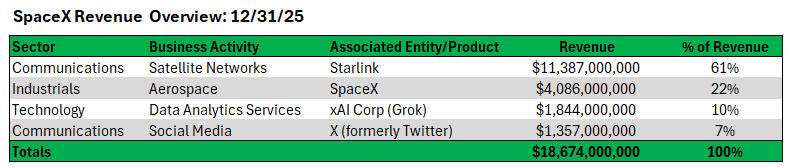
The segment financials reveal stark contrasts in profitability across the corporate structure. In 2025, Starlink achieved $4.423 billion in income from operations, countering a standalone operational loss of $657 million in SpaceX’s core Space segment. On a consolidated level, SpaceX reported an overall loss from operations of $2.589 billion, a bottom-line deficit fundamentally driven by a $6.355 billion operating loss within the newly integrated xAI and compute infrastructure segment.
The inclusion of Starlink has shifted the company's identity from a capital-intensive launch contractor into a high-margin, recurring-revenue subscription titan operating within a massive global connectivity ecosystem. While Elon Musk maintains long-term ambitions for the launch segment — which includes establishing a self-sustaining colony on Mars — the business has effectively been repositioned over the near to intermediate term. Core launch operations now serve as a vertically integrated secondary revenue stream designed to deploy and support a vast digital network. Its Form S-1 filing underscores the unprecedented operational scale the firm has achieved. SpaceX's vertically integrated manufacturing model, producing approximately 70 satellites per week at its Redmond, Washington facility and tens of thousands of Starlink user kits daily in Bastrop, Texas, underpins operations that delivered 170 missions in 2025 and accounted for more than 80% of all mass delivered to orbit worldwide that year. And yet, the story continues to evolve.
With its historic IPO successfully completed, SpaceX is now finalizing its $60 billion all-stock acquisition of Anysphere (Cursor). The deal was originally structured pre-IPO but intentionally deferred to the post-listing window to keep the initial S-1 disclosure clear and avoid any regulatory scheduling delays. The deal, which marks the largest venture back acquisition in history, aggressively expands SpaceX’s AI division as it moves to compete directly with Anthropic, OpenAI, and Google.
The addition of Cursor’s enterprise software business introduces roughly $4 billion in annualized revenue ($2.6 billion from enterprise B2B customers). SpaceX is no longer just a connectivity and launch provider; it is rapidly consolidating into a multi-sector tech conglomerate that seems to defy simple classification. Fortunately, parsing tech giants happens to be a Syntax specialty. Once the transaction closes and audited financial data is released, we will be there to dissect and codify this evolving profile, ensuring investors possess the transparency required to understand what they truly own.