

The Texas Capital Texas Equity Index and the Case for Full Value Chain Energy Exposure
Key Takeaways
- Most large-cap benchmarks allocate only about 3% to energy, despite the sector contributing an estimated 7.4% of U.S. GDP. The Texas Capital Texas Equity Index addresses this gap with a 17.9% energy weight, in line with energy's share of Texas GDP.
- The Index's energy constituents span the full value chain — upstream, midstream, LNG, refining, services, and royalties — making it a diversified position rather than a commodity bet.
- Two structural themes drive the Index's favorable energy positioning: The "behind-the-meter" electrification of AI infrastructure and the West Texas corporate flywheel connecting E&P producers, data centers, and hyperscalers.
For most of the past decade, many investors unknowingly made a decision to underweight energy. As technology's share of the major benchmarks expanded, energy's share contracted to the point where the sector now represents roughly 3% of the S&P 500.1 Despite this, it remains foundational to economic output and, increasingly, to the buildout of artificial intelligence infrastructure. The Texas Capital Texas Equity Index (symbol: SYTXSX), which the Texas Capital Texas Equity ETF seeks to replicate, takes a very different posture to energy exposure. The Index is designed to mirror the Texas economy and sets sector weights to match each sector’s contribution to Texas’ GDP. As of May 31, 2026, 17.9% of the Index was allocated to the Energy sector.2 This places the Index at the intersection of two of the decade’s most critical structural trends: fueling the massive infrastructure demand of the AI revolution and securing a resilient, domestic energy supply chain.
Texas benefits immensely from its strategic geographic location, which places critical energy hubs like the Permian Basin, Eagle Ford, Haynesville, and the Gulf Coast LNG and refining corridor firmly within its borders. Because these major assets are disproportionately Texas domiciled, an index of Texas headquartered companies naturally captures the entire U.S. energy value chain as highlighted on the following page, with reference to specific Index holdings.
Behind the Meter: Electrification and Data Center Growth
The most important new source of energy demand is electricity for AI infrastructure. U.S. data center power consumption is widely projected to roughly double by 20303, with Texas leading new hyperscale construction. Because grid interconnection queues now stretch for years, developers are increasingly building generation “behind the meter”. These are dedicated, often gas-fired energy production facilities co-located alongside the data center itself, which contracts directly with power producers rather than waiting for utility infrastructure.
The Index features independent power producers, such as Vistra (VST), NRG Energy (NRG), and Talen Energy (TLN), that control the reliable power supplies and commercial platforms required to serve large-scale energy consumers in Texas and across the country. The Index also holds an unusually deep bench of engineering and electrical construction firms, including:
- Quanta Services (PWR): electric transmission and distribution construction.
- Comfort Systems (FIX) and IES Holdings (IESC): mechanical and electrical contracting for data centers.
- Powell Industries (POWL): switchgear and electrical distribution equipment.
- Sterling Infrastructure (STRL) and Primoris (PRIM): site development and energy infrastructure construction.
On the energy-supply side, the Index includes key gas compression and distributed power providers that supply the equipment to move gas and generate power at these sites, such as:
- Kodiak Gas Services (KGS) and Archrock (AROC) provide natural gas compression services.
- Solaris Energy Infrastructure (SEI) provides mobile and scalable equipment-based solutions for use in distributed power generation.
The Index also holds the demand side of the equation directly through premier digital infrastructure assets:
- Digital Realty Trust (DLR): One of the world's largest data center operators.
- Applied Digital (APLD) and TSS Inc. (TSSI): AI-oriented digital infrastructure and data center landlords.
With holdings across power producers, contractors, fuel suppliers, and the data center landlords simultaneously, SYTXSX is well positioned to benefit from increased electrification investment.
The Flywheel: Producers, Service Providers, Data Centers, and Hyperscalers
The Permian Basin produces so much natural gas that supply often overwhelms local pipelines, occasionally driving local gas prices down to zero. This makes building gas-powered data centers right next to the gas source incredibly cheap and practical.
This setup creates a win-win-win situation across three sets of businesses:
- Energy producers find a profitable buyer for their excess gas.
- Data center developers get fast, reliable power without waiting to connect to the main electric grid.
- Tech giants (hyperscalers) get their computing centers up and running much faster.
Texas-based Chevron (CVX) provides a good example. In November 2025, Chevron announced a gas-powered plant in West Texas, starting at 2.5 GW, expandable to 5.0 GW.4 It is designed to plug directly into a neighboring data center campus and be up and running by 2027. In April 2026, Microsoft entered exclusive negotiations on the $7 billion project, the largest oil major- hyperscaler collaboration to date.5 The Index holds the critical upstream and midstream infrastructure layers across the Permian Basin to support these types of projects:
- Index constituents Diamondback Energy (FANG), Permian Resources (PR), Matador Resources (MTDR), and EOG Resources (EOG) are among the largest Permian gas- and-oil producers positioned to supply this demand.
- Kinetik Holdings (KNTK) and Targa Resources (TRGP) own the gathering and processing infrastructure that moves the molecules.
Perhaps the most distinctive exposures are the toll-takers on Permian land itself, alongside major tech tenants driving the demand side of the flywheel:
- Texas Pacific Land Corporation (TPL) and LandBridge (LB) together own well over one million acres of West Texas surface and royalty acreage.
- Oracle (ORCL) has emerged as one of the largest contractors of Texas gas-supplied data center capacity.
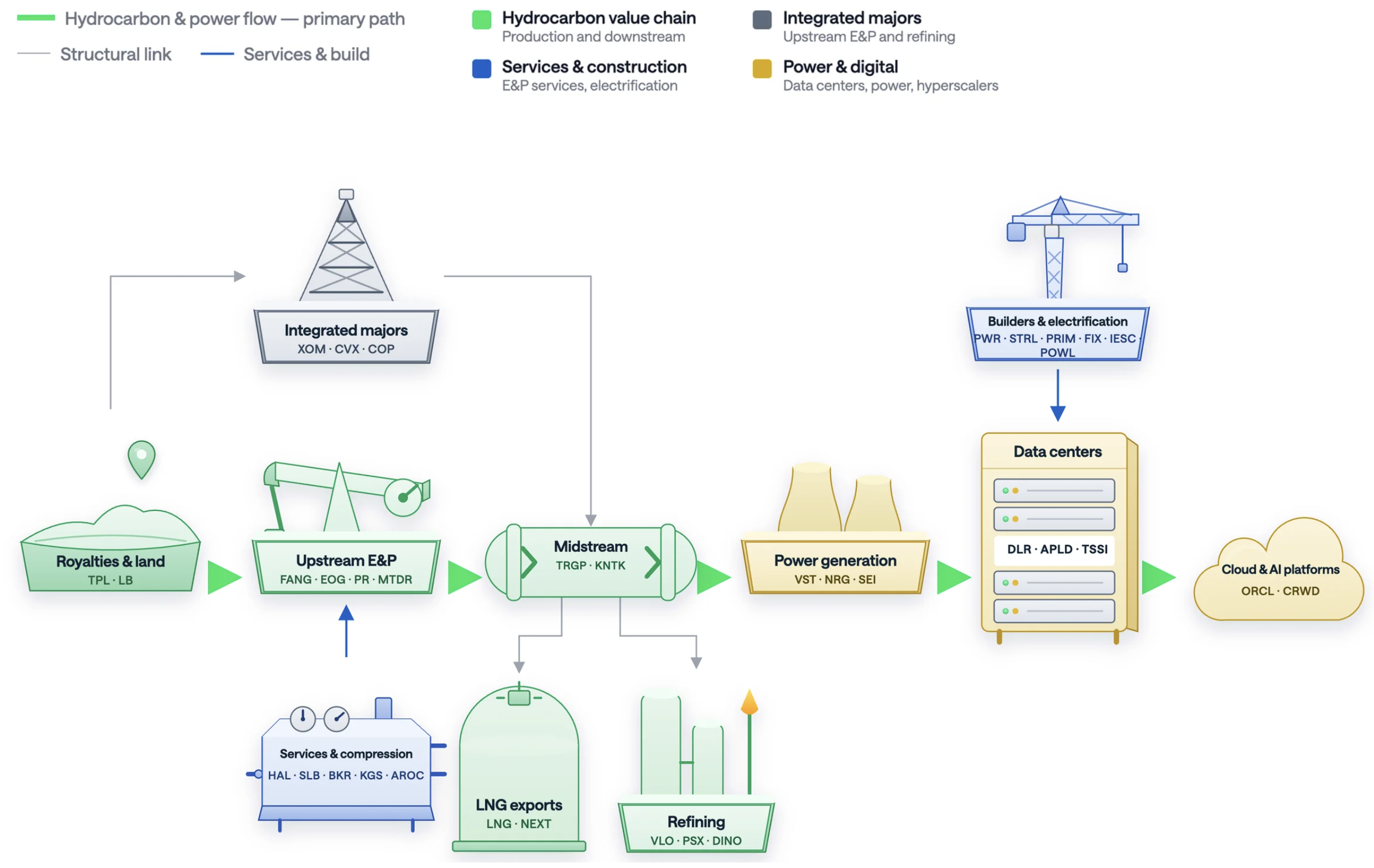
The Energy Value Chain
The graphic below illustrates how the Index's energy-related holdings interconnect to the AI Infrastructure constituents. These companies are broken into four segments:
- Hydrocarbon Value Chain: Energy production and downstream-related businesses.
- Integrated Majors: This category includes Exxon Mobil and Chevron which have Upstream E&P and Refining businesses.
- Services & Construction: Includes companies that facilitate E&P companies that extract hydrocarbons, and companies involved in electrification activity (power suppliers, data centers, and hyperscalers).
- Power & Digital: The data centers, the behind the meter power suppliers, and cloud & AI platform companies (hyperscalers).
The graphic shows eleven business activities and 35 companies that make this energy and digital infrastructure market map.
Energy Value chain and its digital infrastructure linkages
Conclusion
As the global energy landscape undergoes a structural transformation driven by the AI buildout and heightened national security, by virtue of its holdings replicating the GDP of the state of Texas, the Texas Capital Texas Equity Index provides investors exposure to this shift. We believe the Index’s roughly 18% weight to the Energy sector is best understood not as a bet on oil prices, but as diversified ownership of the U.S. energy value chain. For investors with core positions in tech heavy large cap indices like the S&P 500 and Russell 1000 that typically have roughly a 3% weight in energy, we believe the Index offers a structurally differentiated complement.
1. S&P 500 sector weights as of May 31, 2026. Source: S&P Dow Jones Indices.
2. Exposure calculating by aggregating product line exposure of the SYTXSX index constituents using Syntax’s FIS industry classification system.
3. International Energy Agency (IEA), "Energy and AI" Special Report, 2025/2026.
4. Chevron Corporation, press release, November 2025.
5. ,Bloomberg News, March 31, 2026; confirmed by joint statement from Chevron, Engine No. 1, and Microsoft. Fortune described the arrangement as "the largest collaboration to date between a U.S. oil and gas giant and Big Tech" (Fortune, Jordan Blum, April 2026). Note: as of the joint statement, no commercial terms had been finalized, and no definitive agreement was in place.