

Risk-managed equity strategies are often evaluated through the lens of short-horizon outcomes. Investors may ask whether a strategy will reduce losses in the next downturn, outperform during a particular market phase, or deliver a specific payoff profile over a defined horizon. While these questions are understandable, they do not always align with the design objectives of every risk-management approach.
The DF Risk-Managed Tactical Top 30 Index (DF RMT30) is designed with a different emphasis. Rather than defining outcomes over a specific period, the index focuses on how equity exposure behaves across full market cycles. Its objective is not to eliminate volatility or avoid every market decline, but to adjust exposure during sustained market deterioration while maintaining participation in favorable environments.
Understanding what the strategy is designed to do—and what it is not intended to deliver—is therefore an important part of evaluating its role within a broader portfolio.
Designed for full-cycle behavior
DF RMT30 approaches equity risk management through changes in exposure rather than through predefined payoff structures. When market conditions remain favorable, the index stays fully allocated to its equity portfolio. When sustained deterioration in market trend is identified, the allocation shifts to short-term U.S. Treasuries.
This structure reflects a design philosophy focused on long-term portfolio behavior rather than short-horizon outcomes. The allocation framework is intended to engage primarily during extended periods of market stress rather than reacting to routine volatility.
Exhibit 1 illustrates how this design can influence portfolio behavior across multiple market cycles. Changes in exposure during sustained downturns have historically altered drawdown depth and recovery dynamics, while the strategy remained fully allocated to equities during prolonged bull markets.
Exhibit 1: Allocation Framework Adds Considerable Value Through Market Cycles
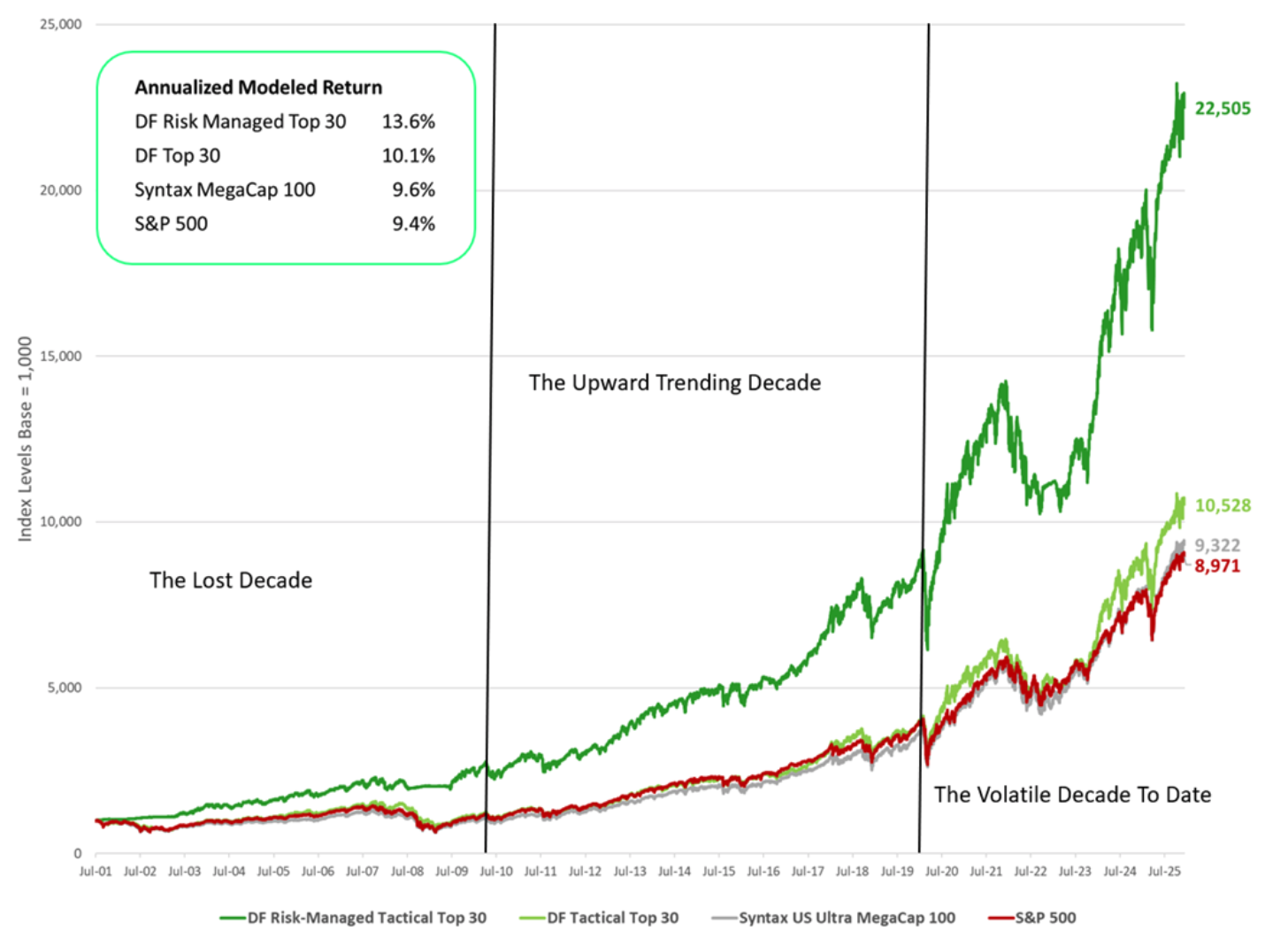
The result is a return pattern shaped by participation in equity advances combined with exposure reductions during extended market declines. Over time, these dynamics influence how the portfolio compounds across different market environments.
Not designed to define short-horizon outcomes
Because DF RMT30 manages risk through exposure adjustments rather than payoff engineering, it does not attempt to define a specific return range over a predetermined period. The strategy does not target a particular buffer against losses over a fixed horizon, nor does it impose a cap on upside participation when equities are held.
This distinction reflects the broader difference between exposure-managed strategies and defined-outcome approaches. Exhibit 2 summarizes the structural characteristics that differentiate these frameworks, including core exposure, risk mitigation mechanism, upside participation, and path dependence.
Exhibit 2: Structural comparison of DF RMT30 and SPRO
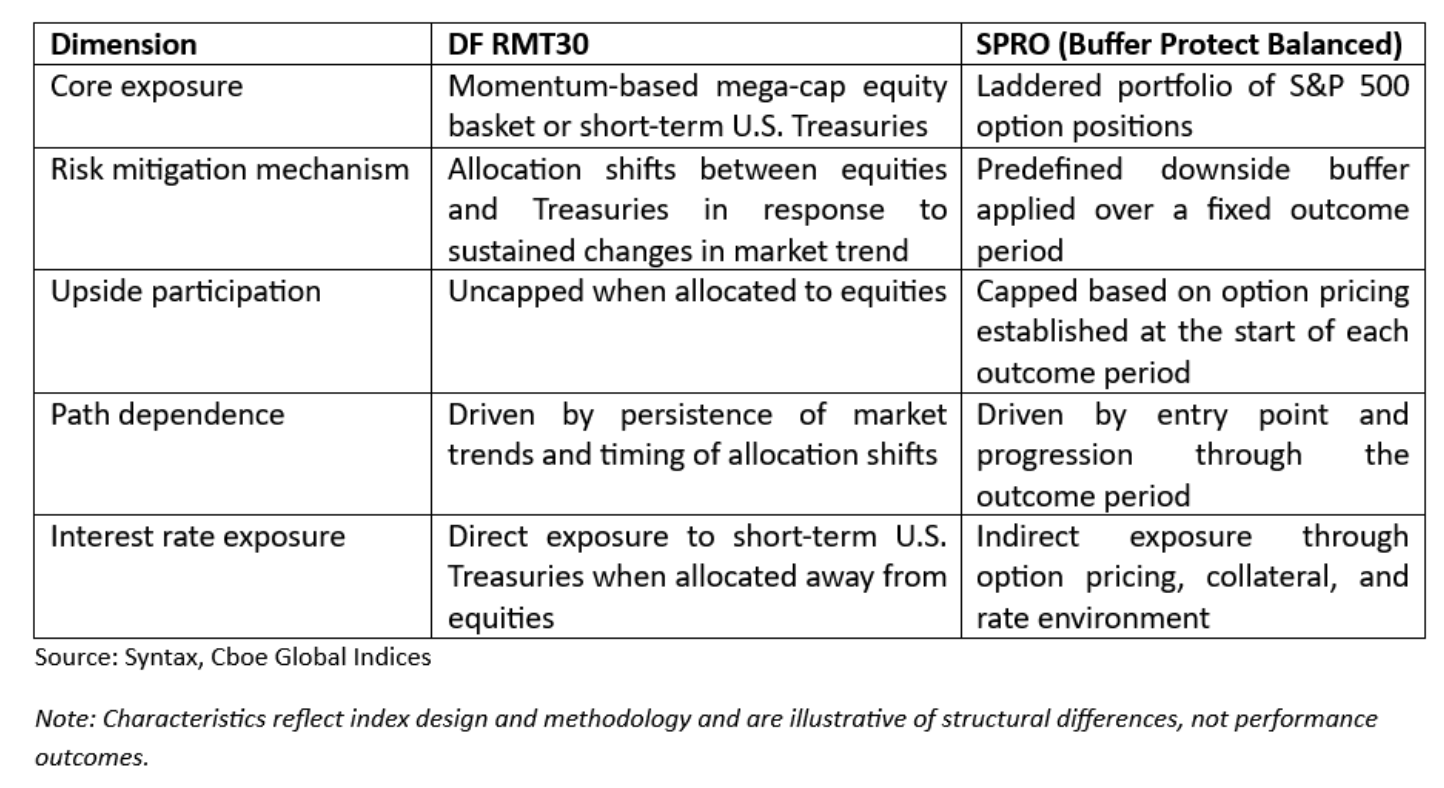
Strategies that define outcomes over a specified period are often designed to deliver a known payoff range at the end of that horizon. Exposure-managed approaches instead focus on adjusting allocations as market conditions and regimes evolve. The resulting performance patterns can therefore differ depending on the persistence of market trends and the timing of allocation changes.
Understanding this distinction helps set realistic expectations for how different types of risk-managed equity strategies may behave.
Positioning within the equity risk-management toolkit
The role of DF RMT30 within a portfolio ultimately depends on the broader investment context. Some investors require clearly defined outcomes over a specific time window, particularly when capital will be spent or redeployed within that period. In those situations, strategies designed around defined payoff profiles may be appropriate.
Other investors operate with open-ended time horizons and prioritize long-term capital growth across multiple market cycles. In these portfolios, the focus is often on maintaining equity participation while managing the depth and duration of major drawdowns.
Exhibit 3 illustrates how these different objectives align with different approaches to equity risk management. Strategies that define outcomes over fixed periods address one set of investor needs, while exposure-managed approaches address another.
Exhibit 3: Framework for selecting equity risk management approaches
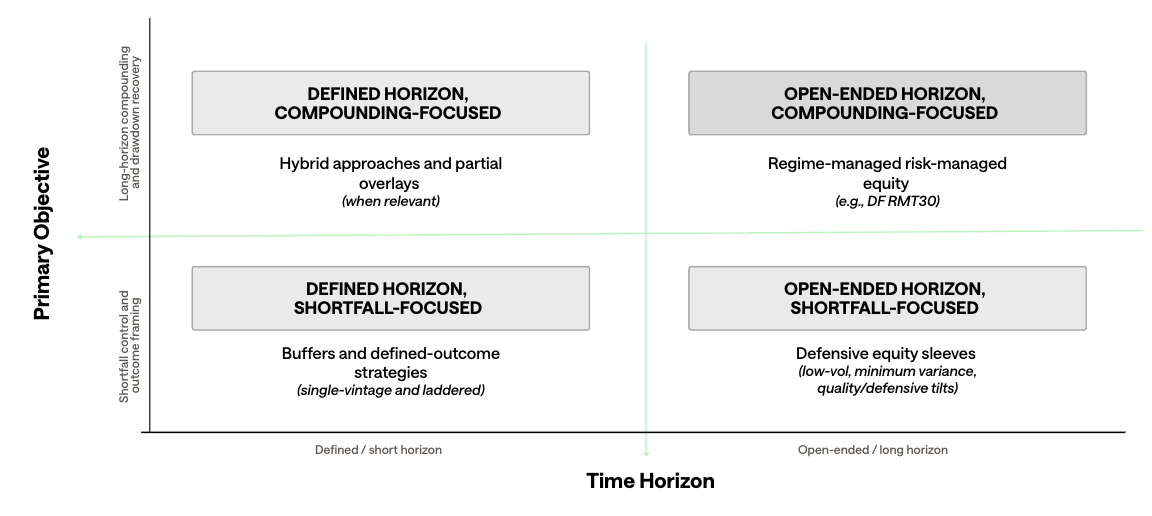
Viewed in this context, DF RMT30 is designed to function as a long-term equity allocation that incorporates systematic exposure adjustments across market regimes.
Clarifying expectations
Clarifying what a strategy is designed to do is as important as understanding what it is not intended to deliver. DF RMT30 is not designed to eliminate drawdowns, nor is it intended to provide a predefined payoff range over a short horizon.
Instead, the index is designed to maintain equity participation during most favorable market environments while adjusting exposure during sustained periods of market deterioration. The objective is to influence drawdown and recovery dynamics over time while preserving exposure to long-term sources of equity return.
Evaluated over full market cycles, this design emphasizes how portfolios behave across changing market conditions rather than how they perform over any single horizon.
Together, these articles outline a framework for thinking about equity risk management through exposure adjustments across market cycles rather than predefined payoff structures.