

How exposure-based equity strategies can fit within long-term institutional allocations
Portfolio construction often requires balancing two objectives that can appear in tension: maintaining meaningful exposure to equity markets while managing the risks associated with large drawdowns. Risk-managed equity strategies have emerged in response to this challenge, offering investors tools to modify the behavior of equity allocations across different market environments.
Many of these strategies are designed around defined outcome periods, providing a specific payoff profile over a fixed horizon. While this structure can be useful when capital will be deployed or spent within a defined timeframe, it reflects only one way to frame the equity risk problem.
For investors with open-ended time horizons, the considerations can differ meaningfully. Institutions such as endowments, foundations, and long-term asset owners often prioritize sustained capital growth across multiple market cycles rather than achieving a defined payoff at a specific date. In this context, risk management is often less about defining short-term outcomes and more about managing how portfolios behave across extended market regimes.
Time horizon and portfolio objectives
The distinction between fixed-horizon and open-ended portfolios plays an important role in determining how risk-managed equity strategies may be used. Investors with a defined horizon frequently focus on limiting losses over a specific time window, particularly when capital will be required for a known liability or expenditure.
By contrast, open-ended portfolios generally focus on maintaining exposure to long-term sources of return while managing the potential impact of large drawdowns. In these portfolios, the primary concern is often how deeply a portfolio falls during market downturns and how quickly it recovers afterward.
Exhibit 1 illustrates how different approaches to equity risk management can align with different investor objectives. Strategies that define outcomes over a specified period may be well suited to situations where capital must be preserved over a known horizon. Approaches that manage exposure across market regimes may be more closely aligned with portfolios focused on long-term compounding.
Exhibit 1: Framework for selecting equity risk management approaches
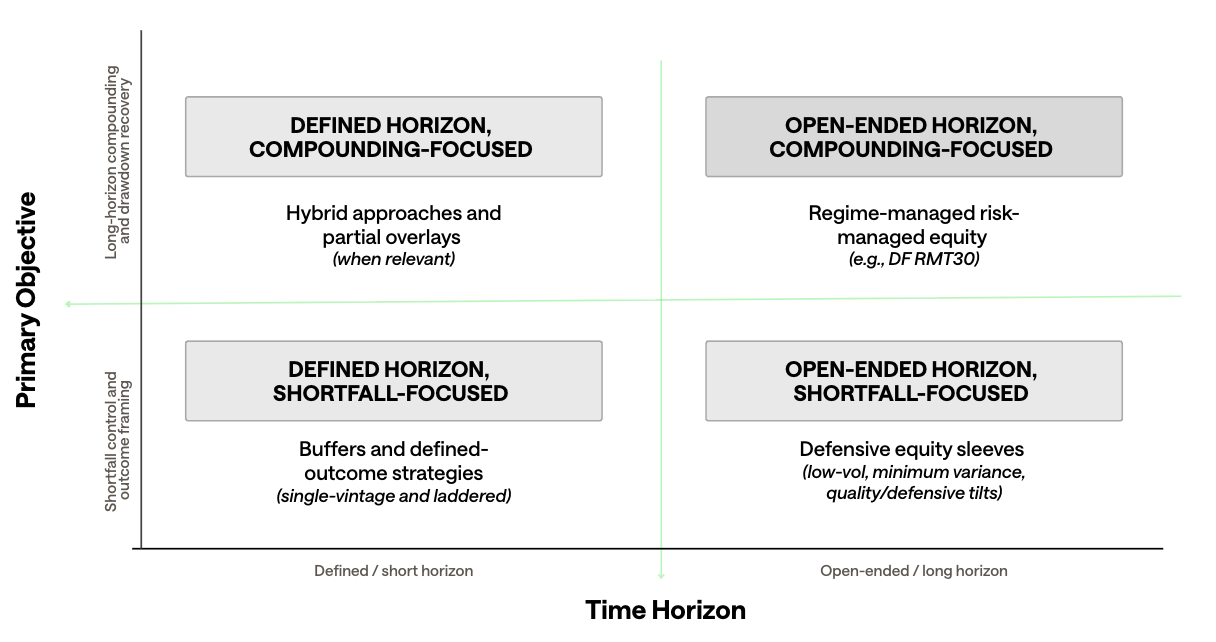
This distinction does not imply that one approach is universally preferable. Rather, it reflects how investment horizon and portfolio objectives influence the type of risk management framework that may be most appropriate.
Exposure management in long-term portfolios
Exposure-based approaches to equity risk management focus on how allocations evolve across market conditions rather than on defining outcomes over a specific period. In these frameworks, risk management occurs through adjustments in portfolio exposure as market regimes change.
For long-term portfolios, this structure can offer several practical advantages. Because exposure remains fully engaged during most favorable market environments, the portfolio retains participation in sustained equity advances. At the same time, allocation adjustments during extended downturns may alter the depth of drawdowns and the time required to recover from them.
Exhibit 2 illustrates how these structural differences can influence long-term compounding. Over extended horizons, strategies that maintain participation in equity advances while managing exposure during prolonged downturns can produce different cumulative return paths than approaches that consistently limit upside participation.
Exhibit 2: Long-term compounding impact on exposure allocation vs buffers
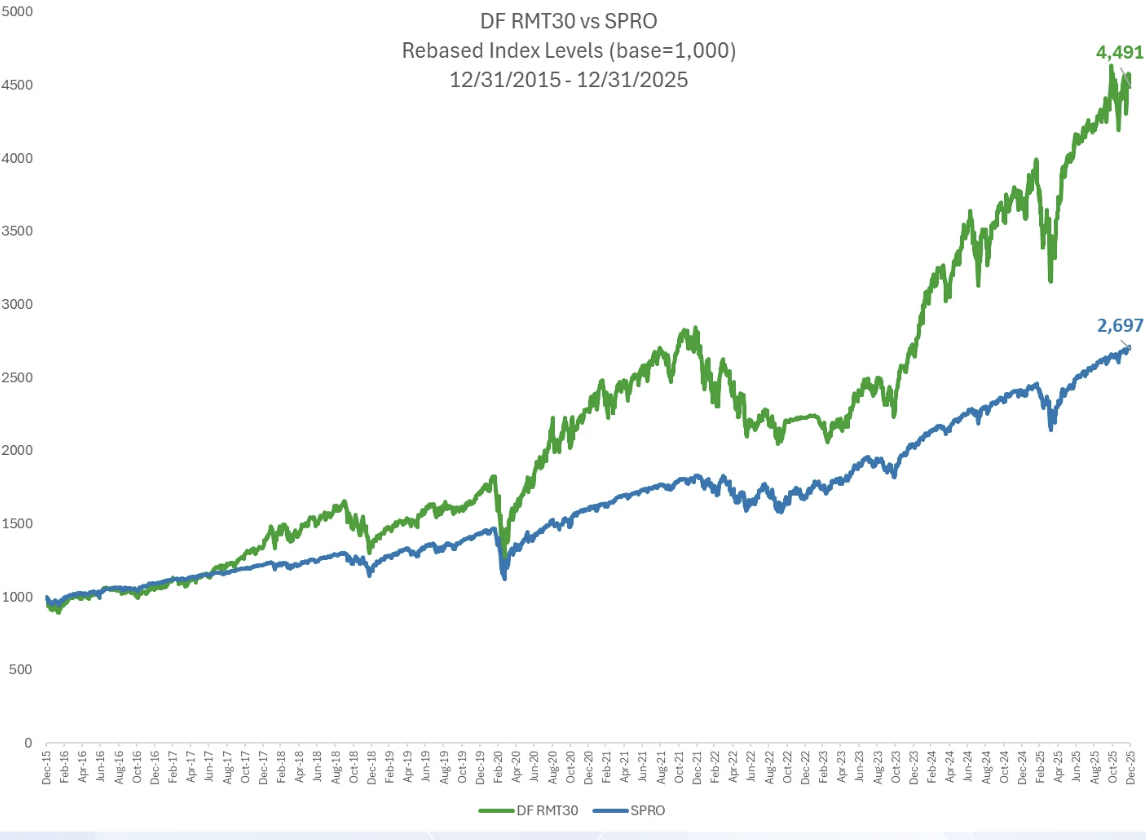
From a portfolio construction perspective, this distinction highlights the importance of aligning strategy design with the underlying objectives of the allocation.
Portfolio integration and diversification
In practice, exposure-managed equity strategies may be incorporated into portfolios in several ways. One approach is to use them within a portion of the equity allocation to introduce a systematic mechanism for adjusting exposure across market conditions.
Exhibit 3 provides an illustrative example of how different portfolio combinations can affect risk and return characteristics. Portfolios that incorporate exposure-based risk management alongside traditional allocations can exhibit different risk-adjusted outcomes over time, reflecting the interaction between equity participation and drawdown behavior.
Exhibit 3: Risk and Return Characteristics of Hypothetical Portfolio Mixes
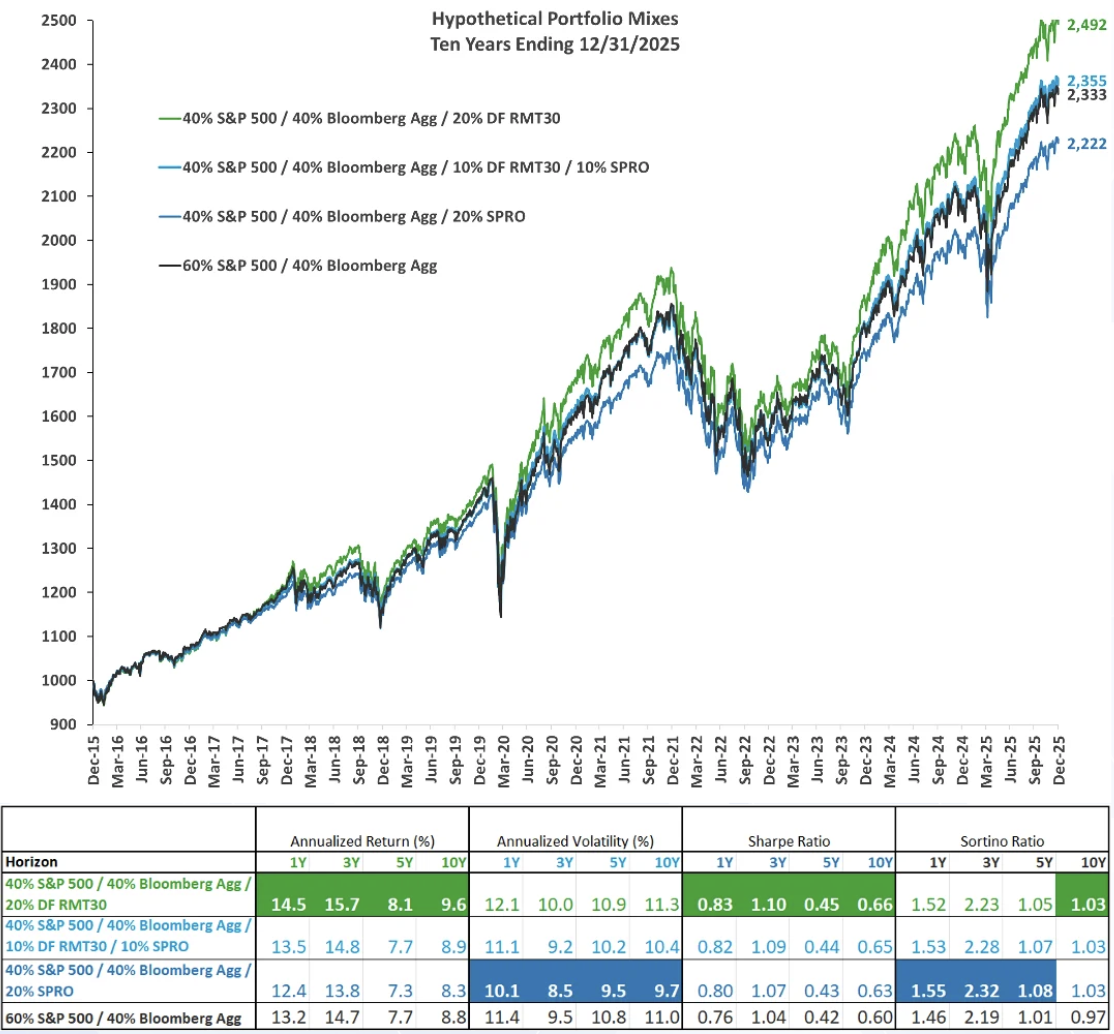
For long-term institutional portfolios, the objective is typically not to eliminate drawdowns altogether. Instead, the goal is to manage the magnitude and duration of those drawdowns while preserving exposure to long-term equity returns.
Aligning strategy design with portfolio context
Ultimately, the role of risk-managed equity strategies depends on the broader context of the portfolio in which they are used. Investors with fixed spending horizons may prioritize clearly defined outcomes over a specific period. Investors with open-ended horizons may focus more on how allocations behave across multiple market cycles.
Exposure-managed approaches are designed to address the latter objective by adjusting equity participation as market conditions evolve. Rather than defining outcomes over a predetermined window, they focus on managing drawdown behavior and recovery dynamics over time.
For institutions seeking to maintain long-term equity exposure while managing the risks associated with large market declines, this framework provides an alternative lens for approaching risk-managed equity allocations.
Disclaimers
Past performance is no guarantee of future results. All performance of the DF Tactical Top 30 and the DF Risk-Managed Tactical Top 30 indices prior to their May 8, 2025 inception is backtested. All performance of the Syntax MegaCap 100 Index prior to its April 25, 2025 inception is backtested. Backtested performance is not actual performance but is hypothetical and is suitable only for institutional audiences. Backtested performance may not be predictive of actual or future performance. Backtested data may reflect the application of the index methodology with the benefit of hindsight, and the historic calculations of an index may change from month to month based on revisions to the underlying economic and/or financial data used in the calculation of the index. Charts and graphs are provided for illustrative purposes only. S&P® is a registered trademark of S&P Global and/or its affiliates. Syntax® is a registered trademark of Syntax, LLC and/or its affiliates.
The DF Tactical Top 30 Index and DF Risk-Managed Tactical Top 30 Index (the “Indices”) are the property of Donoghue Forlines LLC. Syntax LLC is the administrator of the Indices. Funds or portfolios tracking the Indices are not sponsored by Syntax LLC or its third-party licensors. The Syntax US MegaCap Index is the property of Syntax LLC, which is the administrator of the index.
The results shown do not represent the results of actual trading using client assets but were achieved by means of the retroactive application of an investment process that was designed with the benefit of hindsight, otherwise known as back-testing. Thus, the performance results noted above should not be considered indicative of the skill of the advisor or its investment professionals. The back-tested performance was compiled after the end of the period depicted and does not represent the actual investment decisions of the advisor. These results do not reflect the effect of material economic and market factors on decision making. In addition, back-tested performance results do not involve financial risk, and no hypothetical trading record can completely account for the impact of financial risks associated with actual investing.
Index performance does not represent actual fund or portfolio performance, and such performance does not reflect the actual investment experience of any investor. An investor cannot invest directly in an index. In addition, the results actual investors might have achieved also would have differed from those shown because of differences in the timing, amounts of their investments, and fees and expenses associated with an investment in a portfolio invested in accordance with an index. The indices portrayed herein do not charge management fees directly to end investors or incur brokerage expenses, and no such fees, implementation costs or expenses were deducted from the performance shown; provided, however, that the returns of any investment portfolio invested in accordance with such indices would be net of such fees, implementation costs and expenses. Additionally, none of these indices lend securities, and no revenues from securities lending were added to the performance shown.
This research report is for informational purposes only and is not intended to be, nor should it be construed or used as an offer to sell, or a solicitation of any offer to buy, any security or investment vehicle, nor should it be redistributed. Additionally, the information herein is not intended to provide, and should not be relied upon for, legal advice, tax advice, financial advice, or investment advice. You should make an independent investigation of the matters described herein, including consulting your own advisors on the matters discussed herein. In addition, certain information contained in this research document has been obtained from published and non-published sources prepared by other parties, which in certain cases have not been updated through the date hereof. While such information is believed to be reliable for the purpose used herein, such information has not been independently verified by Syntax and Syntax does not assume any responsibility for the accuracy or completeness of such information. Syntax LLC, its affiliates and their independent providers, are not liable for any informational or technical errors, incompleteness, or delays, or for any actions taken in reliance on information contained herein. This document and the information it contains should not be reproduced, redistributed, or used without the prior written consent of Syntax LLC. Distribution of Syntax data and the use of Syntax indices, data, software, or technology to create financial products require a license with Syntax and/or its licensors. Investments are not FDIC insured, may lose value and have no bank guarantee.