

Sentiment is at a record low. Yet discretionary stocks are outperforming the grocery aisle.
Consumer confidence levels have fallen precipitously in recent months. The Michigan Consumer Sentiment Index (CSI), one of the leading measures of consumer sentiment, hit an all-time low of 44.8 in May, sharply down from 56.4 in January. Tariff uncertainty, high gas prices, geopolitical uncertainty, and inflation concerns have all contributed to increasing consumer pessimism.
Sentiment did stage a brief recovery over the summer, but that improvement proved short-lived. In September the index reversed course again, with the final reading of the CSI falling from 51.7 in August to 48.1. That erased much of the summer's gains and underscores how fragile the rebound in consumer confidence has been. The Conference Board's Consumer Confidence Index confirms the decline, falling 6.7 points in September to 81.9, its lowest level since 2014 and below its pandemic-era low.
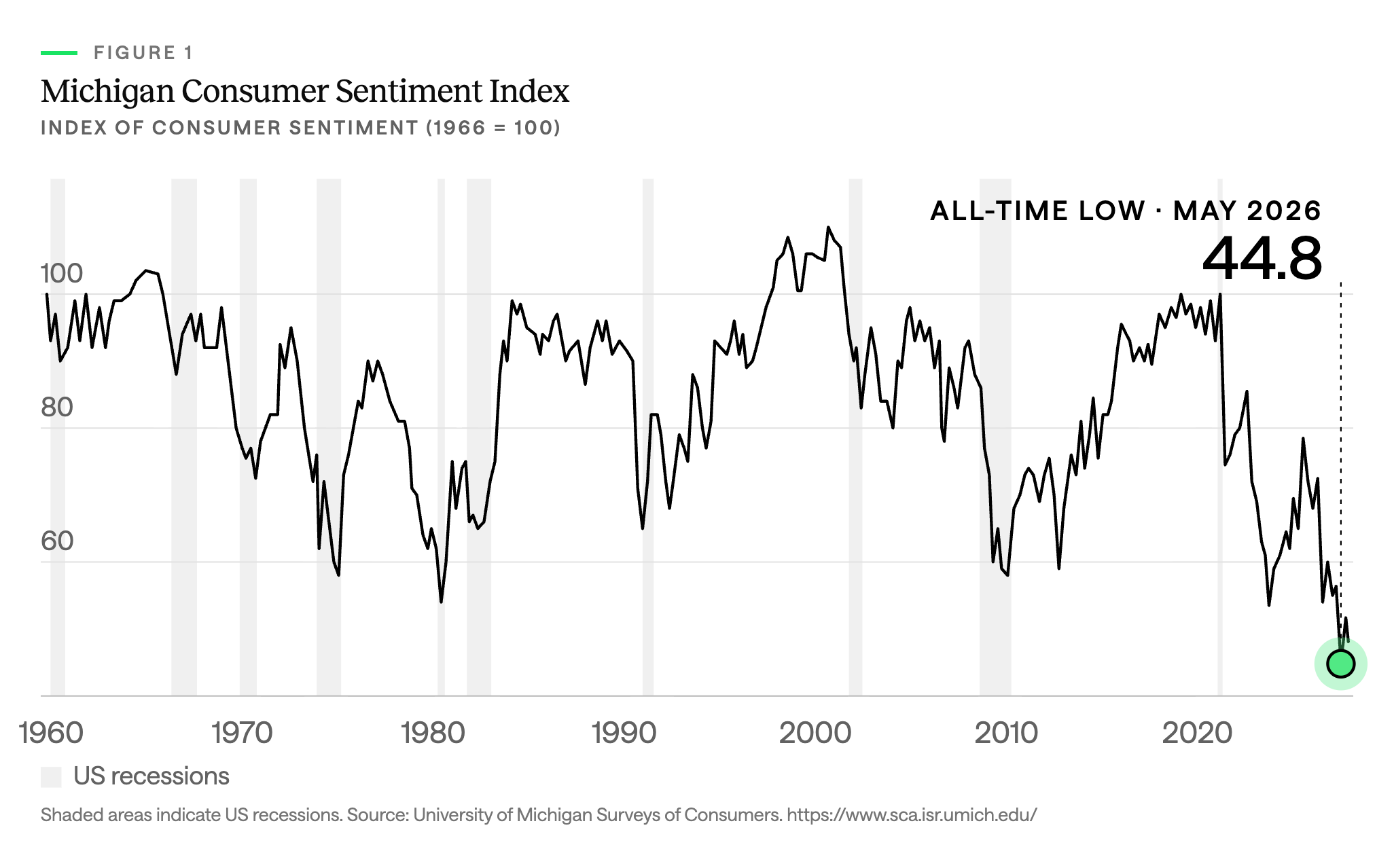
As CSI trends downward once more, it's worth remembering that the index isn't a predictor of consumer spending. It's better understood as a read on how consumers feel about the economy rather than a forecast of how they'll actually behave with their wallets.
Syntax’s granular classification data provide a unique lens through which to understand how consumer-facing businesses have fared through falling confidence levels. Using the Syntax Consumer Lens, we measured the performance of US equities that earn a majority of their revenue from nine different consumer-facing groups, covering a range of sectors.
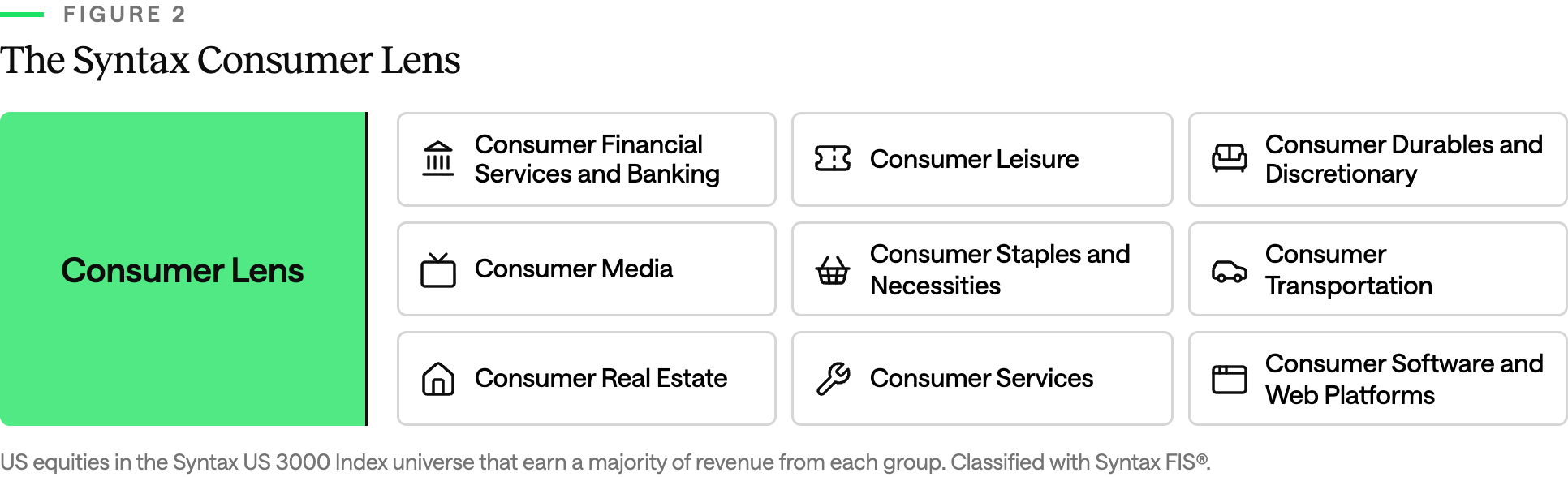
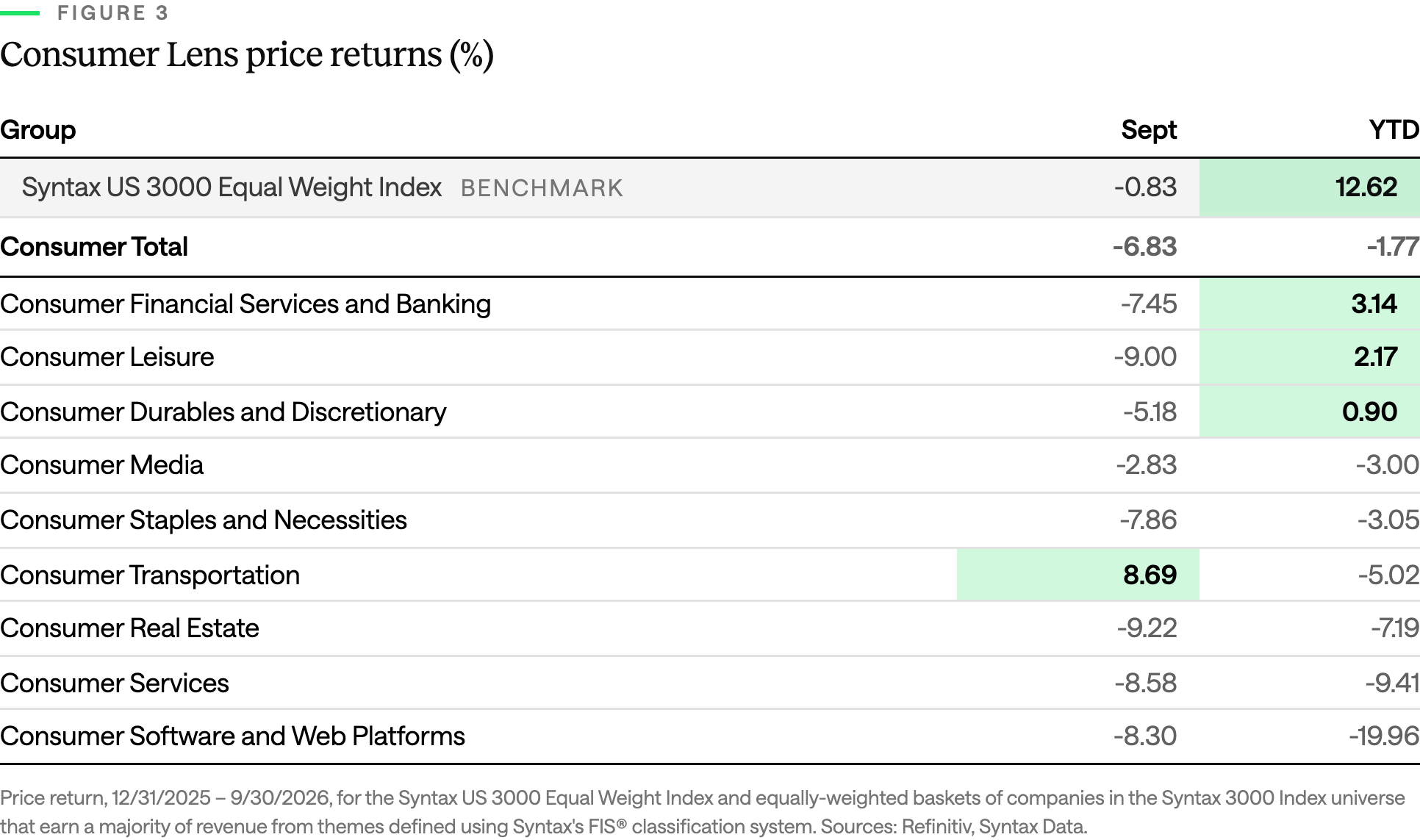
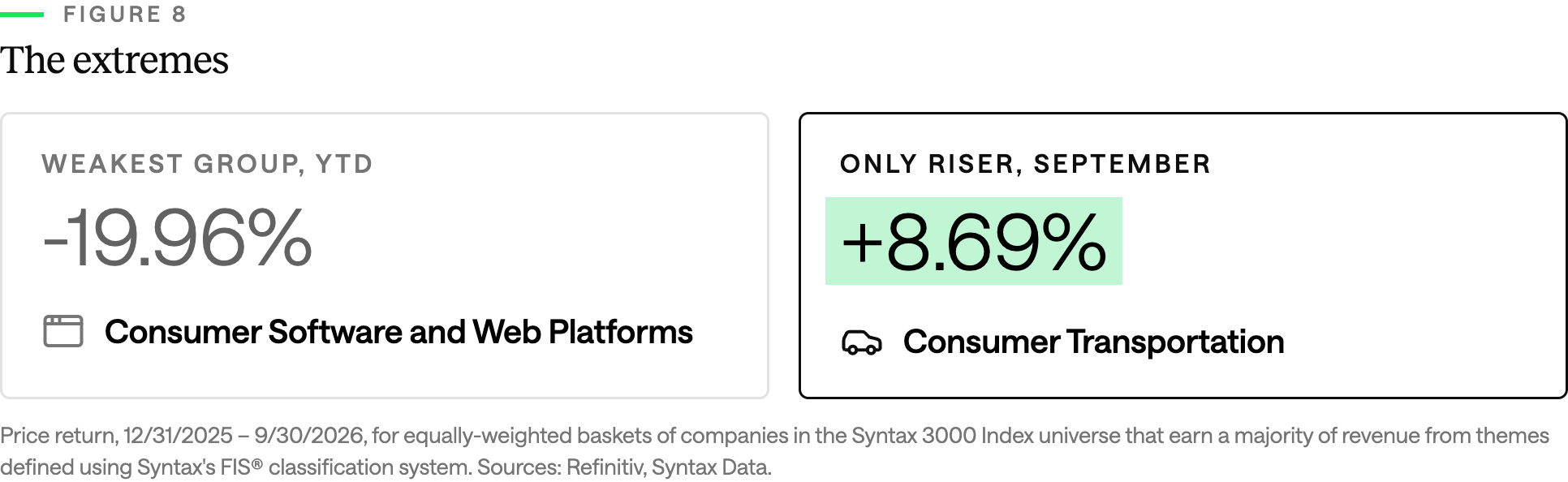
Consumer-facing equities have trailed the broad market all year. The Consumer Total basket fell 6.83% in September against a 0.83% decline for the Syntax US 3000, and it is down 1.77% year to date against a 12.62% gain for the broad index, a lag of more than 14 points. Eight of the nine consumer groups fell in September, with Consumer Transportation the only one to rise.

Consumer Durables and Discretionary fell 5.18% last month but remains up 0.90% year to date, while Consumer Staples and Necessities declined more sharply, down 7.86% last month, leaving the category negative for the year at -3.05%. The broader consumer spending story this year has been shaped by persistently elevated inflation, which appears to be altering how consumers allocate spending relative to historical downturn patterns. During periods of economic pressure, Durables and Discretionary typically take a harder hit than Staples as consumers pull back on non-essential purchases first.
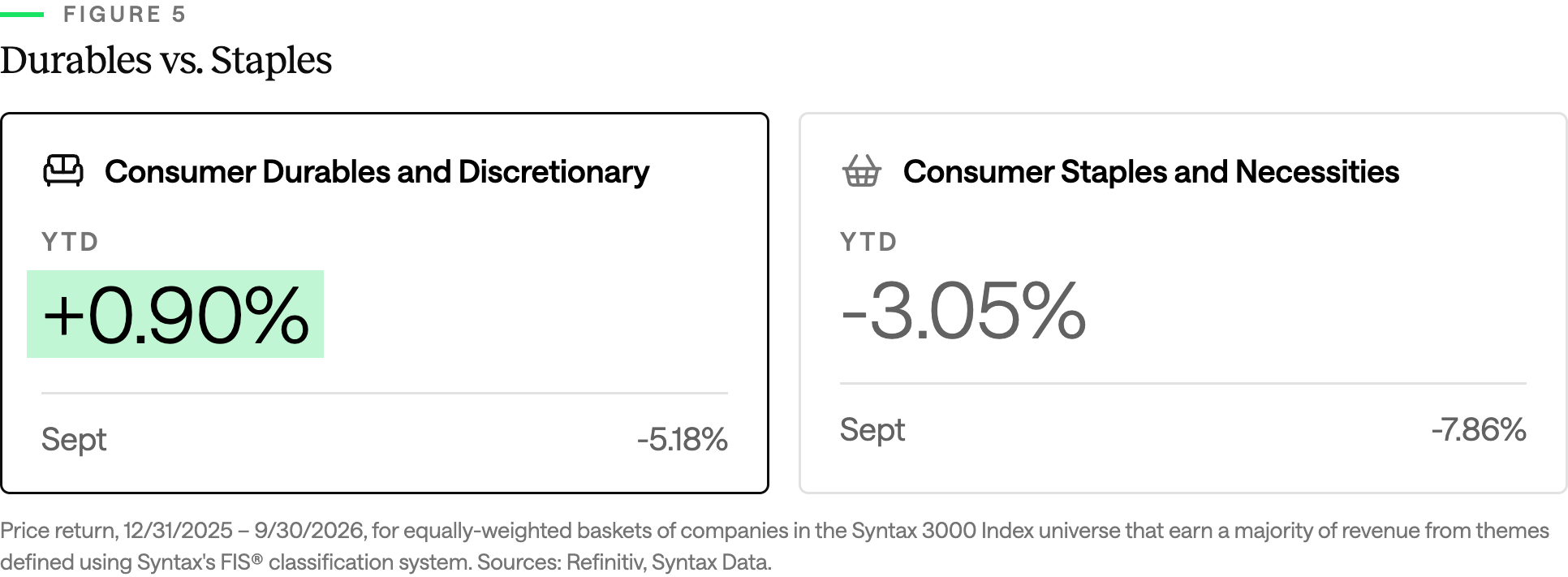
This year the opposite has held over both periods. Staples fell further than Durables and Discretionary last month and trail them year to date, a reversal of the typical defensive rotation. This divergence is consistent with sustained inflation pushing consumer behavior outside the patterns we would normally expect. It is not the only explanation. Staples carry direct rate sensitivity as bond proxies and face input cost pressure on margins, and either would produce the same ranking without any change in spending behavior.
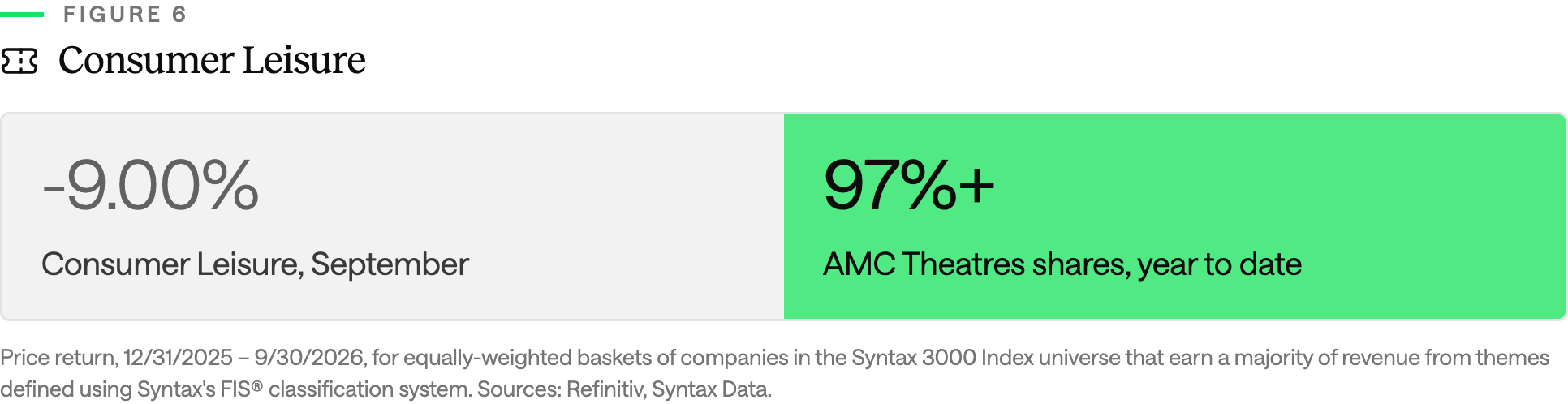
Consumer Transportation and Consumer Leisure moved in opposite directions in September. Transportation rose 8.69% last month and is now down 5.02% year to date, while Leisure fell 9.00% and remains up 2.17% for the year. Both groups have contended with the same fuel shock. Jet fuel prices surged after the outbreak of the Iran conflict, and cruise operators faced the same rise in fuel costs, squeezing margins for airlines and cruise lines even as passenger volumes held up.
Cruises were among the worst-performing themes in our Monthly Thematic Radar last month, down 11.3%, and the group also absorbed a contained hantavirus outbreak aboard the expedition ship MV Hondius that added to public health concerns despite posing very low risk to the broader public. Airlines faced a further headwind early in the year when a Department of Homeland Security funding shutdown led hundreds of TSA officers to leave their posts, driving record security wait times and day-long delays at major airports. Movie theaters have been the clear exception within Leisure. AMC Theatres shares are up more than 97% year to date, with distributors and studios benefiting as well. The Syntax Consumer Lens groups movie theaters with Consumer Leisure given their role as entertainment venues, while production companies fall under Consumer Media. The box office has produced several standout performances this year, though the industry has not fully shaken off its post-pandemic struggles.
Consumer Real Estate equity price returns fell 9.22% in September and are now down 7.19% year to date. On September 16 the Federal Reserve raised its benchmark rate by a quarter point, its first hike since 2023, adding pressure to a housing market already contending with mortgage rates near 7%. The move follows a prolonged stretch of elevated inflation that Fed Chair Kevin Warsh argued needed to be addressed. Mortgage rates remain elevated, and rate hikes have historically made borrowing more expensive, reinforcing headwinds for the housing market rather than easing them.
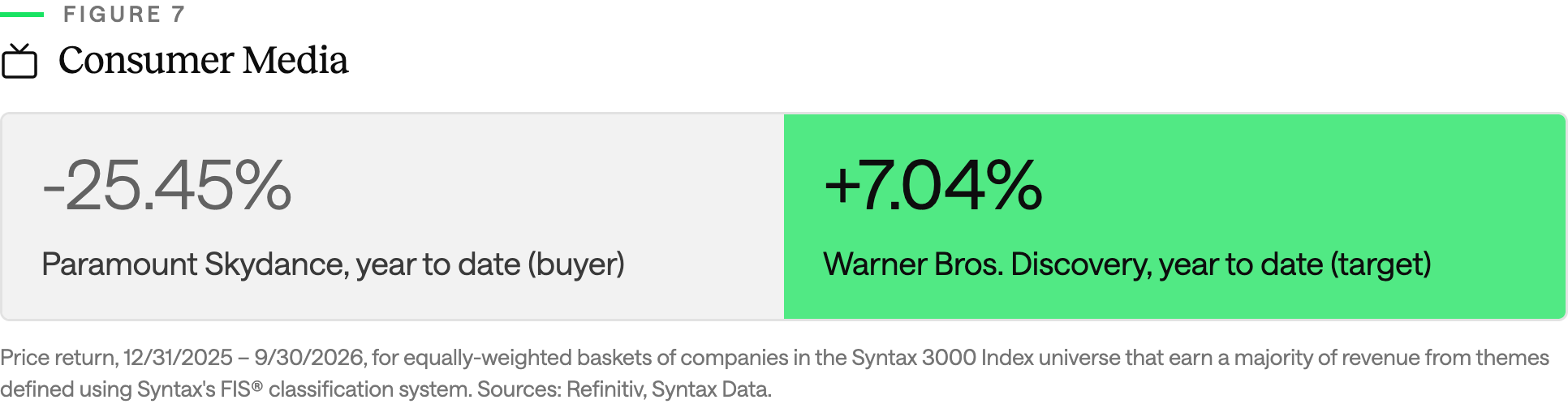
Consumer Media posted a price return of -2.83% last month and is down 3.00% year to date, reflecting a volatile year for production companies and the broader media sector. Much of the sector's recent volatility has centered on its largest story of the year, the pending merger between Paramount Skydance and Warner Bros. Discovery. Paramount Skydance is down 25.45% year to date and Warner Bros. Discovery is up 7.04%, a gap that reflects their opposite roles in Paramount's expected $31.00 per share cash acquisition of WBD. As the buyer, Paramount carries the cost: the deal is expected to leave the combined company with about $79 billion in net debt. WBD, as the target, trades close to the fixed offer price, and its gains held through state and Writers Guild lawsuits filed in July to block the deal. Those suits were settled on September 21, sending WBD sharply higher, while Paramount fell to a one-month low after closing was pushed back, since each day of delay past October 1 adds to the ticking fees it owes WBD shareholders.
The three remaining groups round out the picture. Consumer Financial Services and Banking fell 7.45% in September but remains the best performer of the nine for the year at 3.14%. Consumer Services fell 8.58% last month and is down 9.41% year to date. Consumer Software and Web Platforms, down 8.30% in September and 19.96% for the year, is the weakest consumer group by a wide margin. Consumer Software and Web Platforms has been weighed down this year by investor concern that AI agents could disintermediate consumer platforms, compressing valuations across the group even as most companies are folding AI into their own products. Many analysts view the selloff as overdone, arguing that platforms’ supply networks and user habits are harder to replace than the market has priced in. Taken together, every consumer group except Transportation fell in September, and only three of the nine are positive for the year against a 12.62% gain for the Syntax US 3000. Falling sentiment has not been a reliable guide to which consumer businesses would struggle, but it has coincided with a broad and persistent lag for the consumer complex as a whole.
Disclaimers
This report is for informational purposes only and is not intended to be, nor should it be construed or used as an offer to sell, or a solicitation of any offer to buy, any security or investment vehicle. Additionally, the information herein is not intended to provide, and should not be relied upon for, legal financial, tax, or investment advice. You should make an independent investigation of the matters described herein, including consulting your own advisors on the matters discussed herein. In addition, certain information contained in this report has been obtained from published and non-published sources prepared by other parties, which in certain cases have not been updated through the date hereof. While such information is believed by Syntax to be reliable for the purpose used in this report, such information has not been independently verified by Syntax or Refinitiv and Syntax and Refinitiv do not assume any responsibility or liability for the accuracy or completeness of such information. This report is not sponsored or endorsed by Refinitiv. Syntax LLC, Refinitiv, their affiliates and their independent providers are not liable for any informational or technical errors, incompleteness, or delays, or for any actions taken in reliance on information contained herein. Distribution of Syntax or Refinitiv data and the use of Syntax indices to create financial products require a license with Syntax and/or its licensors. Investments are not FDIC insured, may lose value and have no bank guarantee. Past performance is no guarantee of future results. Charts and graphs are provided for illustrative purposes only.
Syntax® and FIS® are registered trademarks of Syntax, LLC and/or its affiliates. Refinitiv® is a registered trademark of LSEG and/or its affiliates.