

Managing equity risk has become a central challenge in portfolio construction. Many investors seek to remain invested in equities while reducing the impact of market drawdowns. In recent years, defined-outcome and buffer strategies have become a prominent response to this challenge. These approaches reshape the payoff profile of equities by providing a predefined buffer against losses over a fixed horizon while limiting upside participation.
The growth of these strategies reflects a legitimate allocator concern. For many investors, particularly those operating under behavioral, governance, or near-term liability constraints, the path of returns matters as much as long-term outcomes. Buffer strategies address this by defining equity outcomes over a specified period, most commonly one year.
However, framing risk-managed equity primarily through payoff engineering can obscure an important point: altering the payoff structure of equities is only one way to manage risk. An alternative approach focuses not on reshaping returns, but on adjusting equity exposure as market conditions evolve.
Payoff-defined versus exposure-based risk management
At a structural level, risk-managed equity strategies generally fall into two broad design frameworks.
The first defines equity risk through a predetermined payoff structure over a fixed outcome period. Buffer strategies exemplify this approach. They use options to protect against an initial portion of market losses while financing that protection by selling part of the upside potential. The resulting payoff profile is therefore bounded on both sides: losses are partially buffered and gains are capped.
Because these strategies are organized around outcome periods, realized results depend not only on market direction but also on entry timing and the path of returns during the defined window. Two investors buying the same buffer strategy at different points in the outcome period can experience meaningfully different results, even if both hold to the same end date. Laddered implementations attempt to address this by spreading exposure across multiple overlapping outcome periods, but the underlying economics remain tied to capped upside and outcome-period dynamics.
A second design framework manages risk through changes in exposure rather than through predefined payoff structures. Instead of defining outcomes in advance, exposure-based strategies seek to remain invested when conditions are supportive and reduce exposure when sustained deterioration in market trends emerges.
The distinction between these two frameworks is illustrated conceptually in Exhibit 1, which distinguishes between horizon-defined payoff strategies and regime-managed exposure approaches.
Exhibit 1 – Framework for selecting equity risk management approaches
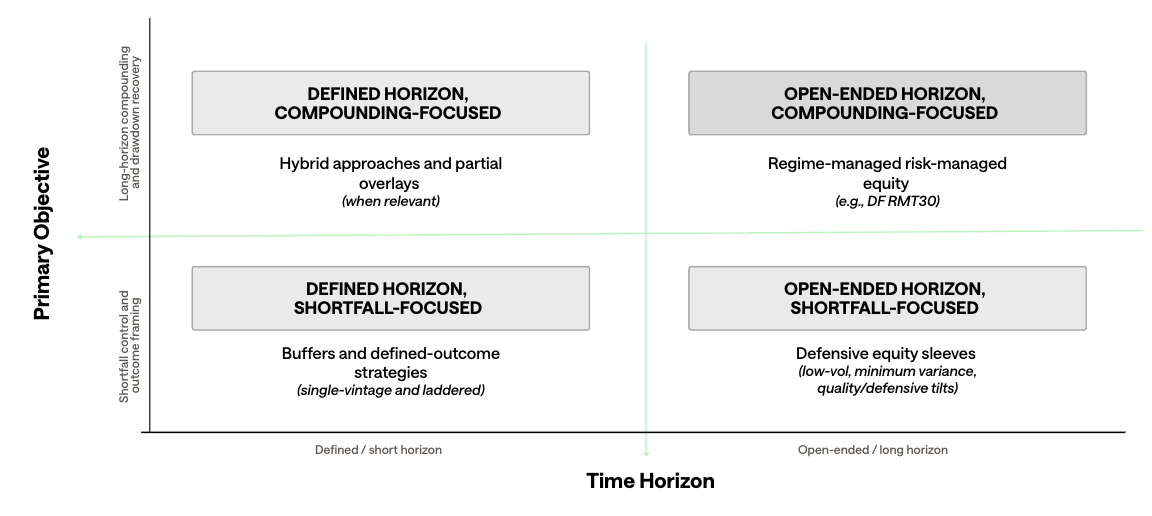
This exhibit illustrates which tools tend to fit different time horizons and objectives. Buffers generally define outcomes over a specified horizon. Regime-managed strategies manage exposure across market regimes without relying on outcome-period payoff structures.
This distinction is more than a structural detail. It influences how strategies behave across market environments and how they fit within broader portfolio objectives.
Risk management through exposure adjustments
Exposure-based approaches treat equity risk management as a function of allocation decisions across market regimes rather than as a payoff engineering problem.
The DF Risk-Managed Tactical Top 30 Index (DF RMT30) provides an example of this framework. Rather than defining a capped payoff profile, the index manages risk through exposure shifts between equities and short-term U.S. Treasuries when sustained market deterioration is identified. When conditions remain favorable, the strategy maintains full equity participation; when longer-term trend signals indicate persistent decline, exposure shifts toward Treasuries.
In this design, drawdown behavior is influenced by allocation changes rather than by predetermined payoff constraints. This can affect both drawdown depth and the time required to recover to prior peaks. Upside participation remains uncapped when the strategy is allocated to equities, while downside mitigation arises from the ability to reduce exposure during extended downturns.
These structural choices result in different expected behavior across market environments. Exhibit 2 summarizes how exposure-based and buffer-based approaches tend to respond under different market conditions.
Exhibit 2 – Expected behavior across market environments
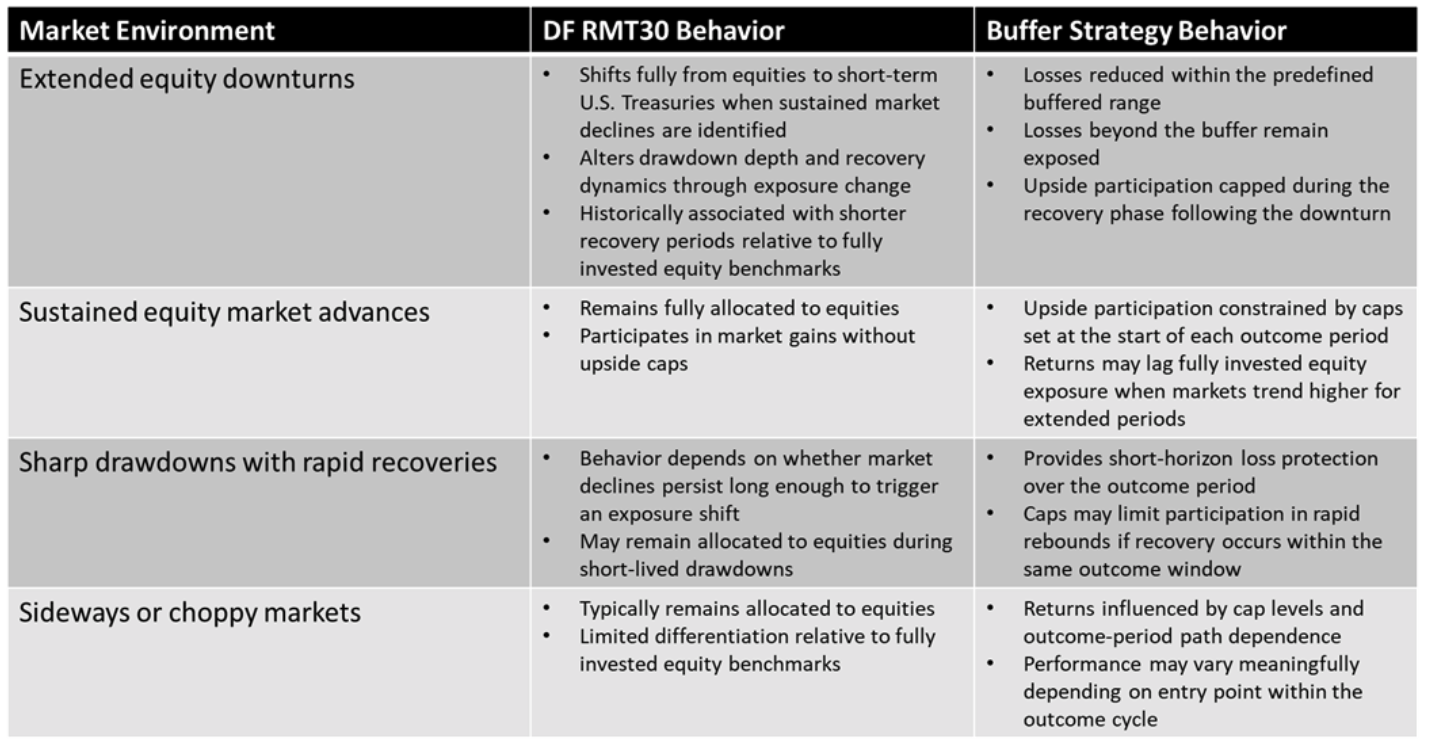
As this exhibit illustrates, strategies that change exposure during prolonged downturns can experience different drawdown and recovery patterns than those built around fixed outcome windows.
During sustained equity downturns, exposure-based approaches may differentiate themselves by shifting away from equities once prolonged market deterioration is identified. Buffer strategies can also reduce losses in such environments through predefined downside protection, although losses may still occur once declines exceed the buffered range.
During sustained equity advances, buffer strategies often lag fully invested equity exposure because upside participation is capped, while exposure-based approaches remain fully invested when conditions remain favorable. In environments characterized by sharp declines followed by rapid recoveries, differences between the approaches may be less pronounced, since the speed of market reversal can limit the role of exposure adjustments.
Implications for portfolio construction
The distinction between payoff-defined and exposure-based approaches ultimately reflects different assumptions about how equity risk should be managed.
Buffer strategies define outcomes over a specific horizon, making them particularly relevant when investors require clarity about potential losses within a defined period. Exposure-based approaches instead focus on how portfolios behave across market cycles, emphasizing participation in favorable markets and adjustments during sustained downturns.
For portfolio construction, the key point is that managing equity risk does not require a single design framework. Payoff engineering and exposure management represent two distinct approaches to addressing drawdown risk within equities.
Understanding the structural differences between these approaches can help investors evaluate how each fits within broader portfolio objectives, time horizons, and governance constraints—and make more deliberate choices about how they want their equity allocations to behave through both bull markets and extended drawdowns.
The next article in this series examines the structural distinction between payoff-defined risk management approaches and strategies that manage risk through changes in market exposure.
Disclaimers